Nepali calendar 2082 BS — your complete month, festival, and FY guide
A complete guide to the year 2082 BS: month-by-month layout, festival cluster, fiscal year window, public holidays, and the AD overlap.
April 14, 2025 · 7 min read
Year 2082 of the Bikram Sambat calendar begins on 14 April 2025 AD and runs to 13 April 2026 AD. It contains the usual twelve Nepali months, the full Dashain–Tihar autumn cluster, the budget cycle of FY 2082/83, and a long list of religious and civic observances. This guide gives you a single reference for the year — month-by-month structure, fiscal calendar, key festivals, public holidays, and conversion notes for daily use.
If you live, work, study, or have family in Nepal, 2082 BS is the year your school terms, tax filings, festival travel, and bureaucratic deadlines will run on. The guide below is built to be a one-page reference you can return to whenever a date needs to be cross-checked, a deadline planned, or a festival noted on the calendar.
2082 BS at a glance
- BS year: 2082
- Starts: 1 Baisakh 2082 = 14 April 2025 AD
- Ends: 30 Chaitra 2082 = 13 April 2026 AD
- Total days: 365 (Baisakh through Chaitra)
- Fiscal year (containing Shrawan): FY 2082/83, 1 Shrawan 2082 to end of Ashadh 2083
- Year before: 2081 BS
- Year after: 2083 BS
- AD years overlapped: 2025 and 2026
Month-by-month layout
Bikram Sambat months are not fixed in length. For 2082 BS the published month lengths are:
| Month | Days | Approx AD window |
| Baisakh | 31 | 14 Apr – 14 May 2025 |
| Jestha | 31 | 15 May – 14 Jun 2025 |
| Ashadh | 31 | 15 Jun – 16 Jul 2025 |
| Shrawan | 32 | 17 Jul – 17 Aug 2025 |
| Bhadra | 31 | 18 Aug – 17 Sep 2025 |
| Ashwin | 31 | 18 Sep – 17 Oct 2025 |
| Kartik | 30 | 18 Oct – 16 Nov 2025 |
| Mangsir | 29 | 17 Nov – 15 Dec 2025 |
| Poush | 30 | 16 Dec 2025 – 14 Jan 2026 |
| Magh | 29 | 15 Jan – 12 Feb 2026 |
| Falgun | 30 | 13 Feb – 14 Mar 2026 |
| Chaitra | 30 | 15 Mar – 13 Apr 2026 |
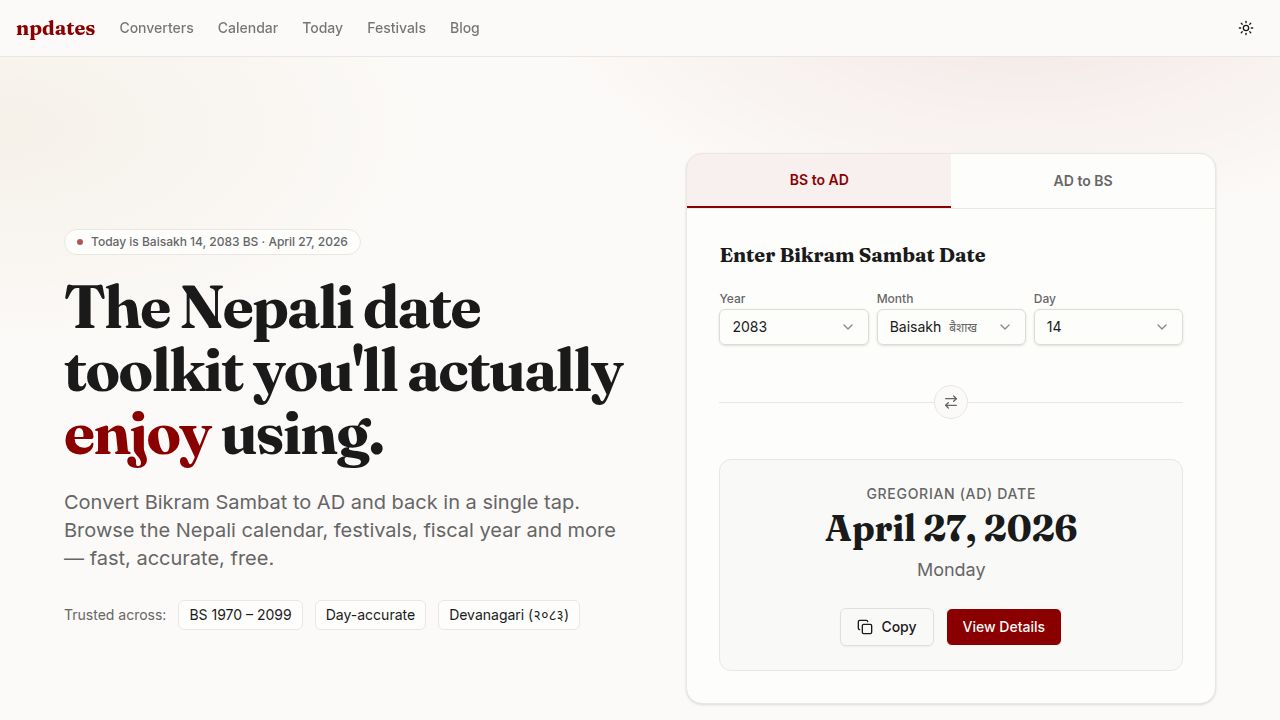
The AD windows shift by a day if 1 Baisakh falls on 13 rather than 14 April; use the BS to AD converter for exact day-of-week and AD date lookups.
Fiscal year 2082/83
Although the BS calendar year starts in Baisakh, the fiscal year (आर्थिक वर्ष) runs 1 Shrawan 2082 to end of Ashadh 2083. Budget day for FY 2082/83 falls on 15 Jestha 2082 (approximately 29 May 2025 AD), when the federal budget is presented to Parliament. The first three months of 2082 BS (Baisakh, Jestha, Ashadh) close out the previous FY 2081/82.
Practical implications:
- Tax filings for the income year ending Ashadh 2082 are due in early FY 2082/83.
- Government salary scales for FY 2082/83 apply from 1 Shrawan 2082.
- New tax rates from the budget take effect at the start of Shrawan.
- Mid-year budget review typically falls in Magh 2082.
For a deeper look at how the FY label works, see Nepali fiscal year explained.
Major festivals in 2082 BS
Festival dates either follow the solar BS calendar (fixed) or the lunar tithi cycle (shifting). The 2082 BS year contains:
- Nepali New Year (Navabarsha 2082) — 1 Baisakh 2082 (14 April 2025).
- Buddha Jayanti — Baisakh Purnima, full-moon day of Baisakh.
- Republic Day (Ganatantra Diwas) — 15 Jestha.
- Janai Purnima and Raksha Bandhan — Shrawan Purnima.
- Gai Jatra — day after Janai Purnima.
- Krishna Janmashtami — eighth tithi of Bhadra dark fortnight.
- Teej (Haritalika) — Bhadra Shukla Tritiya.
- Indra Jatra — Bhadra full moon, Kathmandu's classical street festival.
- Constitution Day (Sambidhan Diwas) — 3 Ashwin.
- Dashain — Ghatasthapana in Ashwin, Vijaya Dashami in Kartik.
- Tihar (Deepawali) — five days in late Kartik.
- Chhath — sixth day of Kartik Shukla, especially in the Terai.
- Maghe Sankranti — 1 Magh.
- Prajatantra Diwas (Democracy Day) — 26 Magh.
- Maha Shivaratri — Falgun dark fortnight.
- Holi (Fagu Purnima) — Falgun full moon; Hill and Terai observe on consecutive days.
- Chaite Dashain (Ram Navami) — Chaitra Shukla Navami.
For the dedicated list of gazetted holidays, see our complete list of public holidays in Nepal.
The AD overlap
BS year 2082 overlaps two AD years:
- 2025 AD — from 14 April 2025 (1 Baisakh 2082) to 31 December 2025 (mid-Poush 2082).
- 2026 AD — from 1 January 2026 (mid-Poush 2082) to 13 April 2026 (30 Chaitra 2082).
This is also where the year-arithmetic mistake bites. From January through mid-April 2026, the AD year has rolled over to 2026 but the BS year is still 2082. People who subtract 57 mechanically will write "2083" — a year ahead of reality. Always use a real AD to BS converter for dates in this window.
School and exam calendar
The Nepali academic year usually starts in Baisakh for community schools and many private schools, with secondary school examinations (SEE) typically held in Chaitra. University academic calendars vary. Tribhuvan University and other major universities run sessions that span the BS year but not always aligned exactly to it.
Notable seasonal markers
- Pre-monsoon — Baisakh to early Ashadh: hot, dry, dust storms in the Terai, occasional pre-monsoon thunderstorms.
- Monsoon — Mid-Ashadh through Ashwin: heavy rains, landslide risk in the hills, flood risk in the Terai.
- Festive autumn — Late Ashwin through Mangsir: clearest mountain views, Dashain–Tihar, wedding season picks up.
- Winter — Poush, Magh, early Falgun: cold in the hills, dense fog in the Terai, occasional cold-wave casualties.
- Spring — Falgun, Chaitra: rhododendrons bloom, Holi, the agricultural calendar restarts.
Planning around the festival cluster
The biggest planning challenge in any BS year is the back-to-back Dashain and Tihar window. In 2082 BS this runs from Ghatasthapana in mid-late Ashwin through Bhai Tika in early Kartik — roughly three weeks of intense festival activity in late September through early November 2025 AD. During this window:
- Domestic and international flights to Nepal book out two to three months in advance. Diaspora-heavy routes (Kuala Lumpur, Doha, Dubai, the US East Coast) see the steepest premiums.
- Long-distance buses from Kathmandu to provincial centres sell out for the days before Phulpati and Maha Ashtami. Plan early or accept higher tourist-coach fares.
- Government offices, courts, and banks are effectively shut for the longer holidays. Visa applications, land registrations, and bank transactions queue up before and after.
- Markets are at their busiest in the week before Ghatasthapana. New clothes, sweets, and household items move in volume.
- Schools and universities close for the combined Dashain–Tihar break, often running into a longer winter break in some institutions.
For a full breakdown of each festival's structure see Dashain dates and Tihar dates. Although those pieces use 2083 dates, the structure and the day-by-day rituals are identical for 2082.
Cross-checking BS and AD dates in 2082
A few date-checking habits save trouble during this year:
- From 14 April to 31 December 2025, the AD year (2025) plus 57 gives the BS year (2082). Easy.
- From 1 January to 13 April 2026, the AD year (2026) plus 56 gives the BS year (2082). The naive +57 here would land you in 2083 — a year off.
- Always cross-check year boundaries near 1 Baisakh (mid-April) and 1 January.
- The age calculator uses 2082-aware logic, so it correctly handles people born just before or just after the BS or AD year flip.
Frequently asked questions
How many days are in 2082 BS?
365 days. Adding the months from the table: 31+31+31+32+31+31+30+29+30+29+30+30 = 365.
When does 2083 BS start?
14 April 2026 AD. See our Nepali New Year 2083 piece for the transition details.
What is the difference between 2082 and FY 2082/83?
2082 is a calendar year (1 Baisakh 2082 to 30 Chaitra 2082). FY 2082/83 is a fiscal year (1 Shrawan 2082 to end of Ashadh 2083). They share the Shrawan-to-Chaitra part of 2082 but diverge in Baisakh-Ashadh.
Is there a 2082 BS holiday I am likely to miss?
The most often overlooked are Constitution Day (3 Ashwin), Prajatantra Diwas (26 Magh), and Chaite Dashain (Chaitra Shukla Navami). All three are gazetted nationally.
How do I look up today's date in 2082 BS?
Use the today in Nepali date page. It shows the current BS date, the corresponding AD date, and the day of the week.
Practical takeaway
2082 BS is a standard-length year with the expected festival cluster and a normal FY 2082/83 budget cycle. If you keep one reference open while working with Nepali dates this year, make it the month-length table above — it lets you reason about any deadline, contract, or festival date without making the year-arithmetic mistake. Pair it with the BS to AD converter for exact day mappings and the date-difference tool for spans across months and years. For year-on-year planning, see also our 2083 BS calendar guide.