Nepali fiscal year explained: why FY 2082/83 starts in mid-July
Nepal's fiscal year runs from 1 Shrawan to the end of Ashadh. Learn how the FY label works, when budgets are presented, and how to map any date to its FY.
October 9, 2025 · 7 min read
Nepal's fiscal year (आर्थिक वर्ष, arthik barsha) does not align with either the Gregorian calendar year or the Bikram Sambat calendar year. It runs from 1 Shrawan to the last day of Ashadh the following BS year — roughly mid-July to mid-July in AD terms. This piece walks through how the fiscal year is structured, why it begins in Shrawan, how to read FY labels, when the budget is presented, and how to figure out which fiscal year any given date belongs to.
The fiscal year window in plain terms
Nepal's fiscal year consists of twelve consecutive months of the Bikram Sambat calendar, beginning with Shrawan (the fourth month) and ending with Ashadh (the third month) the following year. In AD terms:
- The fiscal year starts in mid-July of one AD year.
- The fiscal year ends in mid-July of the next AD year.
- The exact start and end dates shift slightly year to year, depending on how 1 Shrawan and the last day of Ashadh fall in AD.
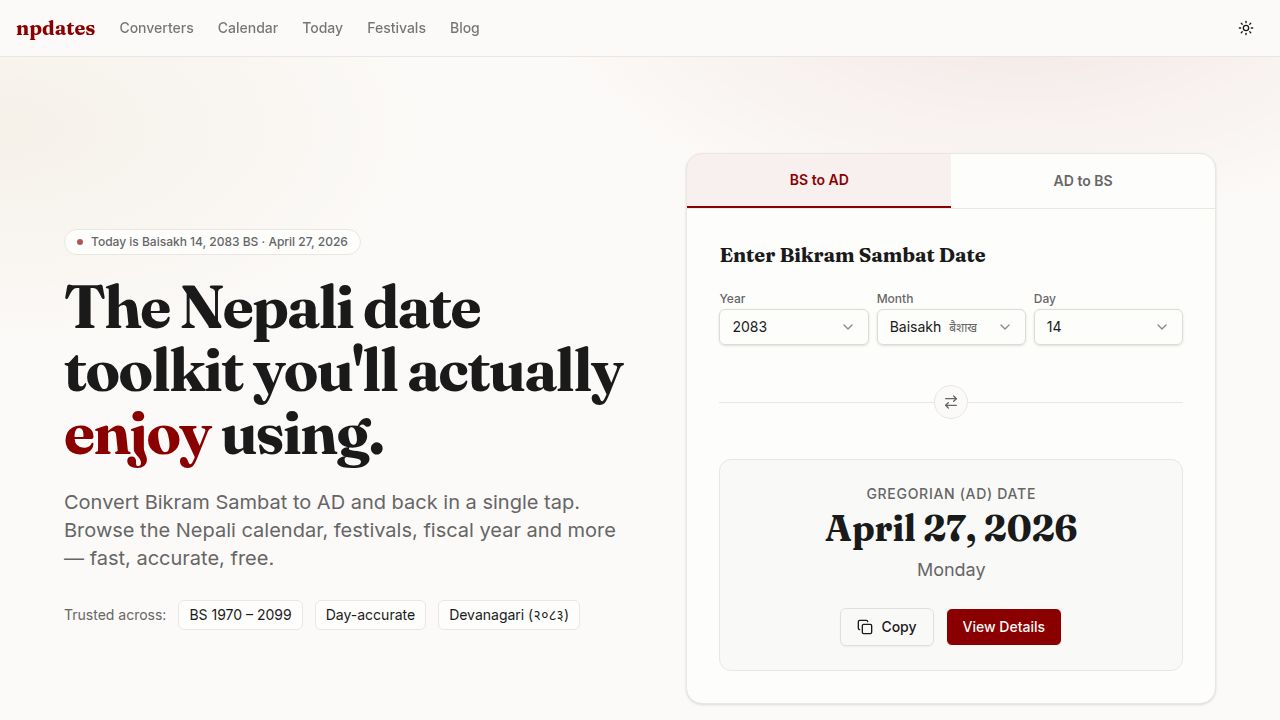
For FY 2082/83, the window is approximately 17 July 2025 to 16 July 2026. For FY 2083/84, it runs from approximately 17 July 2026 to 16 July 2027. You can confirm the exact dates using the BS to AD converter.
How to read FY labels
You will see fiscal years written in several ways:
- FY 2082/83
- FY 2082-83
- आ.व. 2082/083
- आर्थिक वर्ष 2082/083
The first number is the BS year in which Shrawan (the start month) falls. The two- or three-digit second number is the BS year in which Ashadh (the end month) falls. So FY 2082/83 begins in Shrawan 2082 and ends at the end of Ashadh 2083. The crucial point: the second number is always one greater than the first.
Some government documents use the older Nepali convention of writing the second year with three digits (083 rather than 83). The meaning is identical.
Why does the fiscal year start in Shrawan?
The mid-July start has deep agricultural roots. Shrawan is the heart of the monsoon, the month when paddy planting begins. Historically:
- The previous harvest had been threshed, traded, and (where applicable) taxed.
- The treasury could close its books once the rural economy had settled accounts.
- The new planting season needed government support — seed distribution, irrigation works — at the start of Shrawan.
Aligning the fiscal year to this rhythm meant the budget was published when farmers needed it and audited when the harvest had been counted. The administrative calendar still carries the imprint of that agrarian logic, even though Nepal's modern economy is far more diverse than it was when the FY window was set.
Budget day and the FY cycle
The federal budget is presented to the Federal Parliament on 15 Jestha — about six weeks before the fiscal year begins. This is set by Article 119 of the Constitution of Nepal. The cycle for any fiscal year FY X/Y therefore looks like this:
- 15 Jestha (BS year X) — Budget presented to Parliament.
- Jestha to end of Ashadh — Parliament debates and passes the Appropriations Bill.
- 1 Shrawan (BS year X) — Fiscal year begins; new programmes and budget allocations take effect.
- Through Magh — Mid-year review (typically presented in Magh or early Falgun).
- End of Ashadh (BS year Y) — Fiscal year ends. Final accounts close.
- Shrawan onwards (BS year Y) — Office of the Auditor General audits the closed FY; reports follow over the next several months.
For provinces and local levels, the same cycle applies. Provincial and local governments must present their own budgets in line with the federal calendar. They typically do so in late Jestha or early Ashadh, after the federal budget has set the broad envelope.
What changes on 1 Shrawan
On the first day of Shrawan each year, a long list of fiscal and administrative changes take effect:
- New tax rates and threshold changes from the budget become applicable.
- Government salary scales, allowances, and grade revisions take effect.
- New budget headings and programme codes activate in the public accounting system.
- Government contracts dated to the new FY become active.
- Annual progress reporting for the previous FY closes.
For private businesses, the fiscal year matters for income tax filing under the Income Tax Act 2058. Most Nepali businesses are required to use the FY (Shrawan to Ashadh) as their tax year, although some have approval to operate on a different cycle for accounting purposes.
Mapping a date to its fiscal year
Pick any BS date. To find the FY it belongs to:
- If the month is Baisakh, Jestha, or Ashadh, the date belongs to the FY ending in that BS year. For example, 10 Jestha 2083 is in FY 2082/83.
- If the month is Shrawan, Bhadra, Ashwin, Kartik, Mangsir, Poush, Magh, Falgun, or Chaitra, the date belongs to the FY starting in that BS year. For example, 5 Mangsir 2083 is in FY 2083/84.
Put differently: the BS year of Shrawan is always the first number in the FY label. The BS year of Ashadh is always the second.
How the FY interacts with the calendar year
Because the BS calendar year (1 Baisakh to 30 Chaitra) does not coincide with the fiscal year (1 Shrawan to 30 Ashadh), every BS year overlaps two fiscal years:
- BS year 2083 contains the last quarter of FY 2082/83 (Baisakh, Jestha, Ashadh of 2083) and the first three quarters of FY 2083/84 (Shrawan through Chaitra of 2083).
- FY 2083/84 contains the last three quarters of BS year 2083 and the first quarter of BS year 2084.
This is why government reports, statistical bulletins, and audit documents are usually careful to say "FY 2082/83" rather than just "2082" or "2083" — the FY label is unambiguous while the BS year alone is not.
Practical examples
- You want to know which FY a property purchase on 25 Bhadra 2082 falls under. Bhadra is after Shrawan, so the date is in FY 2082/83.
- You want to file taxes for income earned in Magh 2083. Magh is after Shrawan 2083, so this is income for FY 2083/84.
- A tender deadline of 10 Ashadh 2084 closes in FY 2083/84 — Ashadh 2084 is the last month of that FY.
Frequently asked questions
Why does Nepal use a different fiscal year from India?
India's fiscal year runs 1 April to 31 March, aligned to the British colonial inheritance. Nepal never adopted that system; it kept the Shrawan-to-Ashadh window that matches the agricultural and traditional revenue cycle.
Can a business set its own fiscal year?
Most Nepali businesses must use the FY for tax purposes. Some — typically subsidiaries of foreign companies — apply for approval to use a calendar-year accounting basis, but the income tax computation still ultimately aligns with the FY window.
When is the supplementary budget presented?
If the government needs additional appropriations mid-year, a supplementary budget is presented later in the FY — usually in Magh or Falgun, after the mid-year review.
How does FY interact with monthly salary cycles?
Government salaries are paid monthly on a BS calendar basis. The new FY does not change the pay cycle, but it can change pay scales, allowances, and tax deductions starting from 1 Shrawan.
What if the budget is not passed before 1 Shrawan?
The Constitution allows the government to issue a vote on account or use the previous year's budget for up to four months while the new appropriation is finalised. This has happened during politically unstable periods.
Practical takeaway
Nepal's fiscal year is a fixed feature of public and business life: 1 Shrawan to end of Ashadh, every year. Remembering the rule — the first number in the FY label is the BS year of Shrawan, and the second is the BS year of Ashadh — keeps you from misreading government documents, tax notices, and budget reports. If you need to convert a fiscal year start or end date to AD, the BS to AD converter is the quickest route, and the date-difference tool handles the full 365-day FY span if you need to count working days or remaining time.