BS vs AD: every difference between the two calendars, explained
Bikram Sambat and Gregorian use different epochs, different month systems, different new-year days, and converge only on the weekday. Here's exactly how they differ.
October 1, 2025 · 7 min read
Nepalis live with two calendars at once. The Bikram Sambat (BS) calendar runs the country's official paperwork, festivals, fiscal year, and school cycle. The Gregorian (AD) calendar runs international travel, foreign business, online services, and most of what people see on global news. Most of the time you can ignore the difference; the rest of the time, getting it wrong creates real problems. This article lays out every meaningful difference between the two calendars and shows where the practical implications matter.
Different starting points
The first and most basic difference is the epoch — the year each calendar counts as year one.
- The Gregorian calendar counts years from the traditional birth year of Christ. The year before 1 AD is 1 BC. The system is the international civil standard, used by every UN body and most national governments.
- Bikram Sambat counts years from 57 BCE, the era associated with King Vikramaditya. That gives a constant offset: BS is roughly 56 years and 8 months ahead of AD.
The key word is ahead. BS is never behind AD. 2026 AD overlaps with 2082 BS and 2083 BS, not 1969 BS or any earlier year. If you ever see a number that looks smaller than the AD year, something is wrong.
Different new-year days
The Gregorian new year falls on 1 January. The Bikram Sambat new year falls on 1 Baisakh, which lands in mid-April — most commonly on 13 or 14 April. The exact AD date shifts by a day or two from year to year, because the BS new year is tied to the sun's entry into Aries (Mesh rashi), not to a fixed Gregorian date.
This single fact is responsible for most of the confusion when people try to convert between the two systems. When the AD calendar rolls over from 31 December to 1 January, nothing happens in BS — the BS year only changes three and a half months later. For more on the 2083 transition specifically, see our guide on Nepali New Year 2083.
Different month structures
Gregorian months have fixed lengths. January is always 31 days, February is 28 or 29, and so on. Once you have memorised the rhyme, you know every month forever.
Bikram Sambat is different. Months can be 29, 30, 31, or 32 days long, and the length of any given month varies from year to year. This is because BS is a sidereal solar calendar: a month begins when the sun enters a new zodiac sign, and the time the sun spends in each sign is not uniform. The annual patro published by Nepal's Calendar Determination Committee specifies the lengths for each year ahead of time.
Practical implications:
- You cannot assume "three months equals about 90 days" in BS. It might be 88, 91, or 93 depending on which months are involved.
- You cannot write "32 Chaitra" without checking — Chaitra is usually 30 or 31 days, but Shrawan and Ashadh often stretch to 32.
- Validation matters. Our BS to AD converter refuses invalid day-month combinations.
Different month names
The twelve Gregorian months are January, February, March, April, May, June, July, August, September, October, November, December. The twelve BS months are Baisakh, Jestha, Ashadh, Shrawan, Bhadra, Ashwin, Kartik, Mangsir, Poush, Magh, Falgun, Chaitra. There is no one-to-one mapping — Baisakh straddles mid-April to mid-May, Jestha straddles mid-May to mid-June, and so on. A full month-by-month reference is in our piece on the 12 Nepali months in order.
Same week, same weekdays
This is the one place the two calendars agree. Both share the same seven-day cycle, and the weekday on any given physical day is identical in both. Sunday is आइतबार, Monday is सोमबार, Tuesday is मंगलबार, Wednesday is बुधबार, Thursday is बिहीबार, Friday is शुक्रबार, and Saturday is शनिबार.
This consistency is why BS converters can give you a reliable day of the week without ambiguity. If our converter says 15 Magh 2082 falls on a Wednesday, the corresponding AD date (28 January 2026) is also a Wednesday.
Different leap-year mechanics
The Gregorian calendar uses an explicit leap-year rule: every four years gets a 29 February, with corrections every 100 and 400 years. The rule is purely arithmetic; you can determine whether any year is a leap year with a one-line formula.
Bikram Sambat has no equivalent. The extra fractional day each year is absorbed by varying the month lengths. There is no "leap day" in BS, just months that quietly stretch by a day when needed. This is why a closed-form BS-to-AD formula does not exist and why every reliable converter relies on a pre-computed table. For the full story, see how BS-to-AD conversion actually works.
Different fiscal years
The Nepali fiscal year runs from 1 Shrawan to the end of Ashadh — roughly mid-July to mid-July in AD. The Gregorian-aligned international fiscal year (used by the IMF, World Bank, and most multilateral bodies) runs January to December. This means Nepal's budget cycle, audit cycle, and tax filings all sit on the BS calendar, while reports to international partners may need to be re-cut to a Gregorian year-end. For a deeper look, see our piece on why FY 2082/83 starts in mid-July.
Different uses in everyday life
Which calendar matters depends on what you are doing.
- Civil documents in Nepal — citizenship, passports, school certificates, property papers, tax returns — primary date is BS, often with AD secondary.
- International travel and visas — exclusively AD. Embassies do not accept BS dates.
- Religious observances — most are tied to BS or to the lunar tithi calendar that runs alongside it.
- Banking — state-owned Nepali banks lean toward BS; private and international banks tend toward AD.
- News and journalism — Nepali-language outlets default to BS; English-language outlets default to AD.
- Software and APIs — generally AD internally, with BS as a display layer. Our JSON API exposes both formats.
Why does Nepal keep BS as the official calendar?
Three reasons:
- Cultural continuity. Festivals, agricultural cycles, family observances, and the popular vocabulary of seasons all run on BS. Switching the civic calendar would not erase the BS-based reality of daily life.
- Astronomical accuracy. The sidereal solar approach tracks the actual position of the sun against the stars. It is not necessarily "better" than the Gregorian system, but it is internally consistent and well-suited to Nepal's agrarian rhythm.
- Institutional inertia. Every law, contract, gazette, and archival record in Nepal is dated in BS. Migrating the entire institutional memory of a state to a different calendar would be enormous.
Frequently asked questions
If I add 57 to an AD year, will I always get the BS year?
No. From January through mid-April the correct offset is 56, not 57. After mid-April it switches to 57 for the rest of the year. The cleanest fix is to use a real converter and stop relying on mental arithmetic.
Is the time of day different in the two calendars?
No. Nepal Standard Time (UTC+5:45) is the same regardless of which calendar you are reading. The calendar only changes how you label the date, not how you measure the day.
What about the lunar calendar?
Many Hindu festivals run on the lunar tithi calendar, which sits alongside BS. The patro publishes both — the BS solar date and the tithi — so people can plan observances. For more on this dual layout, see our Nepali patro guide.
Can I express my date of birth in either calendar?
Yes, but international forms always want AD. Your Nepali passport already prints both. For a step-by-step on converting your DOB safely, see how to convert your date of birth.
Why does the BS year not change at midnight on 31 December?
Because the BS year starts on 1 Baisakh, which falls in mid-April. The midnight of 31 December is just an ordinary day in the middle of Poush.
Practical takeaway
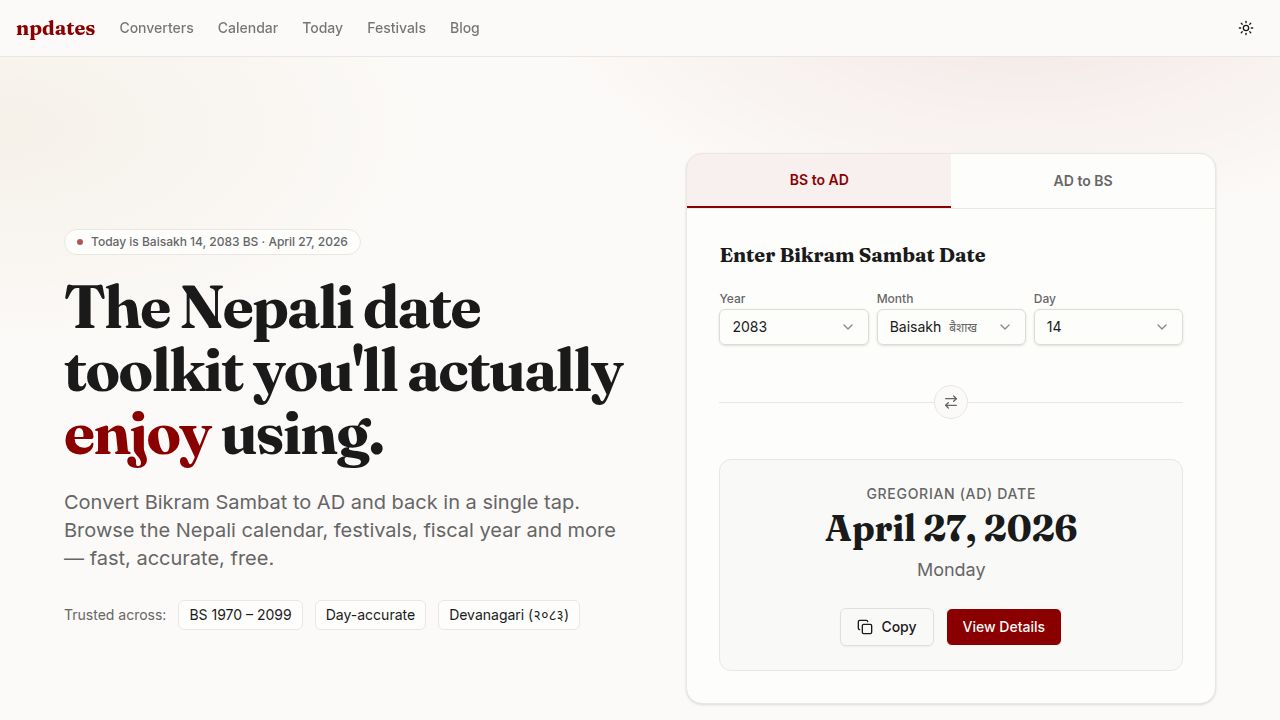
You do not need to choose between BS and AD — Nepal uses both. What you do need is a clear sense of when each calendar applies, and a reliable way to translate between them when it matters. Use the BS to AD converter for Nepali documents you want to read in AD, the AD to BS converter for the reverse, and the today in Nepali date page when you simply want to know what today is in both systems.