How to convert your Nepali date of birth from BS to AD — step by step
Passports, visas, foreign universities and international jobs require your DOB in AD. A practical, error-free guide to converting your Nepali BS birth date.
February 3, 2026 · 6 min read
If you were born in Nepal, the date of birth on your citizenship certificate, school-leaving certificate (SLC/SEE) and most official Nepali records is in Bikram Sambat (BS). Anything international — passport applications, visa forms, foreign university admissions, overseas job postings, bank KYC for international transfers — requires your date of birth in the Gregorian (AD) calendar. Converting accurately is essential. A one-day error sounds minor but can cause visa rejections, identity-mismatch flags during background checks, and ongoing administrative headaches later.
This guide walks through the conversion step by step, covers the common mistakes that trip people up, and shows you how to verify your result against documents you already have.
Why your BS and AD dates don't differ by a fixed number
The most common mistake is to assume that subtracting 56 or 57 from your BS year gives the right AD year. This works most of the time, but fails for a specific window each year. The reason is that the BS new year falls on 1 Baisakh, which lands in mid-April AD — not on 1 January. So:
- For births between mid-April and 31 December AD, the BS year is AD year + 57.
- For births between 1 January and mid-April AD, the BS year is AD year + 56.
A worked example: a person born on 5 Baisakh 2040 BS was born on 18 April 1983 AD — the year offset is 57 (2040 – 1983). But a person born on 5 Magh 2040 BS was born on 17 January 1984 AD — the year offset is 56 (2040 – 1984). Same BS year, different AD years.
This is why you need a real converter, not pen-and-paper subtraction. For the full mathematical explanation, see our how BS to AD conversion works article.
Step 1: locate your BS date of birth
Your authoritative BS DOB appears on one or more of these documents:
- Citizenship certificate (Nagarikta) — the primary civil identity document in Nepal. The DOB is printed in BS, sometimes with the day of the week.
- Birth registration certificate — issued by the local ward office.
- School-leaving certificate (SLC/SEE) — usually in BS, occasionally with both BS and AD.
- Passport — this is special: the passport always carries your AD date of birth, derived at the time of issuance from your citizenship's BS date.
If multiple documents disagree, the citizenship certificate is the legal source of truth in Nepal. Get any discrepancies corrected through the District Administration Office before you start travelling internationally on inconsistent dates.
Step 2: convert with a verified tool
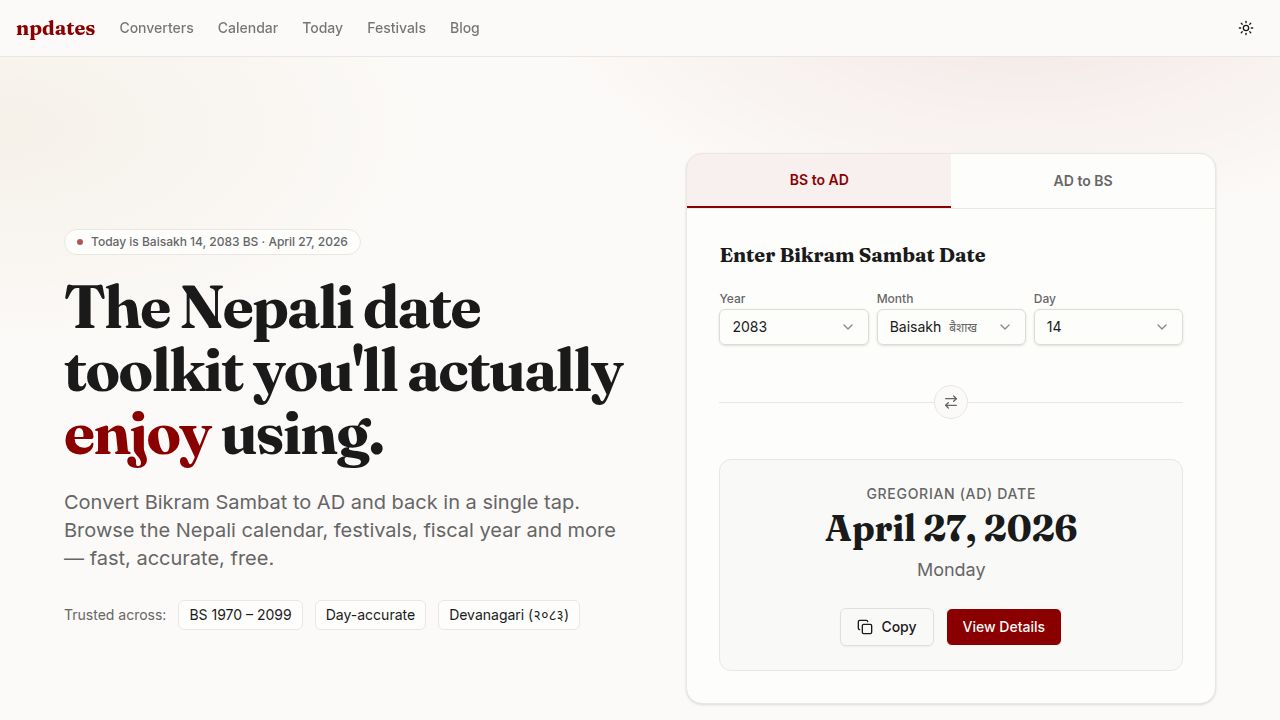
The fastest, most reliable method is to use the BS to AD converter:
- Open the converter on the homepage.
- Enter the BS year, month and day from your citizenship certificate.
- The converter returns the exact AD date and the day of the week.
This takes a few seconds and avoids all the arithmetic pitfalls. The converter uses Nepal's official month-length tables from 1970 BS through 2099 BS, so it will work for anyone born in that range — effectively every living Nepali.
Step 3: cross-check against your passport
If you already have a Nepali passport, your AD date of birth is printed on the data page and embedded in the Machine-Readable Zone (MRZ) at the bottom. Compare:
- The AD date the converter returned
- The AD date printed on your passport
If they match — you are done. Use the passport AD date on your visa application.
If they differ — do not silently "correct" one to the other on your visa form. Differences usually mean the passport was issued with an old or inconsistent conversion. Get the discrepancy resolved at the District Administration Office (for citizenship) or the Passport Office (for passport) before you submit any new international application. Cross-document mismatches can trigger visa refusals.
Step 4: format the AD date for the destination
Different international systems expect different date formats. Once you have your AD year, month and day, write them in the format the form expects:
- YYYY-MM-DD (ISO 8601) — used in many online forms and Canada IRCC
- DD/MM/YYYY — used in UK, Australia, Schengen states
- MM/DD/YYYY — used by US DS-160 visa applications
- DD-MMM-YYYY (e.g. 14-APR-1990) — used by some airlines and banks
Always include leading zeros for months and days under 10: write 04, not 4. Inconsistencies in zero-padding can cause data-entry rejections in strict government systems.
Common mistakes to avoid
- Subtracting 57 every time — fails for Baisakh, Jestha, Ashadh births that fell before mid-April AD (rare but real).
- Writing 32 days when there are fewer — Nepali months can be 32 days but not always. Check the converter before writing a day that doesn't exist.
- Mixing US and UK date formats — 04/05/1990 is 4 May 1990 in the UK and 5 April 1990 in the US. Confirm which format the form expects.
- Using the original birth-paper date when your citizenship corrects it — some older birth papers had estimated dates; the citizenship certificate's date is the legal one.
- Ignoring the day-of-week field — some Nepali official forms ask for the day of the week as well. The day of the week is the same in both BS and AD, but you must report what the converter says, not what you guess.
What to do if you don't know your BS date of birth
Some Nepalis born in remote areas have approximate BS dates on their original birth records, or no birth record at all. In that case:
- Consult older family members who may remember the day relative to a known event (a festival, the year of a major political event, a season).
- Apply for a delayed birth certificate at your local ward office, providing whatever supporting evidence you have.
- Once you have an official BS date, use the converter to get the AD equivalent and apply this consistently to all future documents.
Going abroad with inconsistent or estimated DOBs almost always causes trouble down the line. It is worth investing a few weeks in fixing the underlying record before you apply for your first international visa.
For accountants and HR teams handling many records
If you process many Nepali documents — for example as an HR team for an international firm or as a manpower agency — you may want to integrate the converter into your workflow. The site provides a free API that returns AD dates for any BS input, suitable for batch conversion of employee records. The embeddable widget can also be added to internal HR forms so candidates enter their BS DOB once and the AD equivalent appears automatically.
Practical takeaway
Convert once, verify against your passport, and write the AD date down in a secure place. Most adults will need their AD DOB dozens of times across their life — for visas, banking, foreign jobs, university admissions, even airline frequent-flyer accounts. Getting it right the first time saves a lot of re-paperwork.
Frequently asked questions
What is the AD equivalent of 2040/04/12 BS?
Use the BS to AD converter — enter 2040 / 04 / 12 (year / month / day). Each BS date has exactly one AD equivalent, calculated from Nepal's official month-length tables.
Why is my passport DOB different from what the converter says?
Most likely the passport was issued with an outdated conversion or rounded estimate. Cross-check both against your citizenship certificate and get the passport corrected if needed — do not change your visa application to fit one document over the other.
Is there a single offset I can apply to all my BS dates?
No. The offset is 56 years 8 months on average but varies by exact date. Use the converter or our BS vs AD differences guide.
Can I trust the AD year on my school-leaving certificate?
Generally yes, but cross-check it against your citizenship and passport. SLC/SEE dates are sometimes printed in BS only, with the AD year derived later.
How do I handle the conversion if my BS date is on the year boundary?
For dates in Baisakh, Jestha or Ashadh, be especially careful — the AD year is sometimes one less than the simple BS – 57 rule suggests. Always verify with the converter.