What is Bikram Sambat? A complete guide to Nepal's official calendar
Bikram Sambat (BS) is Nepal's official solar calendar, running about 56 years and 8 months ahead of the Gregorian AD calendar. Learn its origin, structure, and modern use.
September 12, 2025 · 7 min read
Bikram Sambat (Devanagari: विक्रम सम्बत, abbreviated BS or B.S.) is the official solar calendar of Nepal. It is named after the legendary king Vikramaditya and pre-dates the Gregorian (AD) calendar by approximately 56 years and 8 months. While much of the world organises civic life by the Western calendar, Nepalis schedule their fiscal year, school terms, government deadlines, religious festivals, and a large share of daily life by BS.
If you have ever looked at a Nepali citizenship card, a school certificate, or a property document and seen a date like 15 Shrawan 2078, you have already met Bikram Sambat. This guide explains where the calendar came from, how it is put together, why it still runs Nepal's civic clock, and how you can move between BS and AD without making the classic mistakes.
A short history of Bikram Sambat
The Bikram Sambat era starts in 57 BCE. Tradition attributes the start of the era to King Vikramaditya of Ujjain, who is said to have inaugurated the calendar after a military victory. The historical record is thinner than the legend, but the era has been in continuous use across parts of South Asia for more than two thousand years.
In Nepal, Bikram Sambat was formally adopted as the official calendar in the early twentieth century during the Rana administration, replacing the older Shaka Sambat in government use. Since then it has remained the calendar of record for the state — every government office, every tax return, every gazette notice, and every civil document in Nepal carries a BS date as its primary timestamp.
How the calendar is structured
Bikram Sambat is a sidereal solar calendar. That phrase is worth unpacking, because it explains almost everything that surprises newcomers about how BS behaves.
- Solar means the year is tied to the sun's apparent motion through the sky — specifically, to the time it takes the sun to return to the same position relative to the fixed stars.
- Sidereal means the reference frame is the fixed stars (the zodiac), not the equinoxes. This makes BS roughly 24 minutes longer per year than the tropical Gregorian year.
- Each of the twelve months begins when the sun enters a new zodiac sign (rashi). Because the sun does not spend exactly the same number of days in each sign, the months are not all the same length.
The result is a calendar in which a single month can be 29, 30, 31, or even 32 days long, and the length of any given month varies slightly from year to year. This is unlike the Gregorian calendar, where January is always 31 days and April is always 30. The annual patro — Nepal's published almanac — sets out the exact month lengths for the year ahead.
The twelve Nepali months
In order, the months are Baisakh, Jestha, Ashadh, Shrawan, Bhadra, Ashwin, Kartik, Mangsir, Poush, Magh, Falgun, and Chaitra. In Devanagari they are written बैशाख, जेठ, असार, साउन, भदौ, असोज, कार्तिक, मंसिर, पुस, माघ, फाल्गुन, चैत. The year begins on 1 Baisakh, which falls in mid-April of the Gregorian calendar — most commonly on 13 or 14 April.
If you would like a fuller tour of the months — their names, average lengths, and the festivals each contains — see our piece on the 12 Nepali months in order.
Why does Nepal still use Bikram Sambat?
Most countries that historically used regional calendars have shifted to Gregorian for civic life. India did so in 1957 for administrative use. Nepal kept Bikram Sambat for several reasons:
- Astronomical accuracy. The sidereal solar method tracks seasons reliably, which matters for an agrarian society planning sowing and harvest.
- Cultural identity. BS is woven into festivals, naming ceremonies, weddings, and rituals. Replacing it would touch far more than civil paperwork.
- Institutional inertia. Once every law, contract, and historical record is written in BS, a switch becomes prohibitively expensive.
In practice modern Nepalis use both calendars in parallel. A schoolchild knows that the new academic session starts in Baisakh; a software developer knows that an international flight leaves on a specific Gregorian date; a government clerk knows that a tender deadline is set in BS. The two calendars sit comfortably side by side.
The most common conversion confusion
Many newcomers (and quite a few Nepalis) assume that adding 56 or 57 to an AD year always gives the correct BS year. This is only roughly correct. Because the BS new year falls in mid-April:
- From mid-April to 31 December, the offset is generally +57 (e.g. 1 June 2025 AD = 18 Jestha 2082 BS).
- From 1 January to mid-April, the offset is generally +56 (e.g. 1 January 2026 AD = 17 Poush 2082 BS, not 2083).
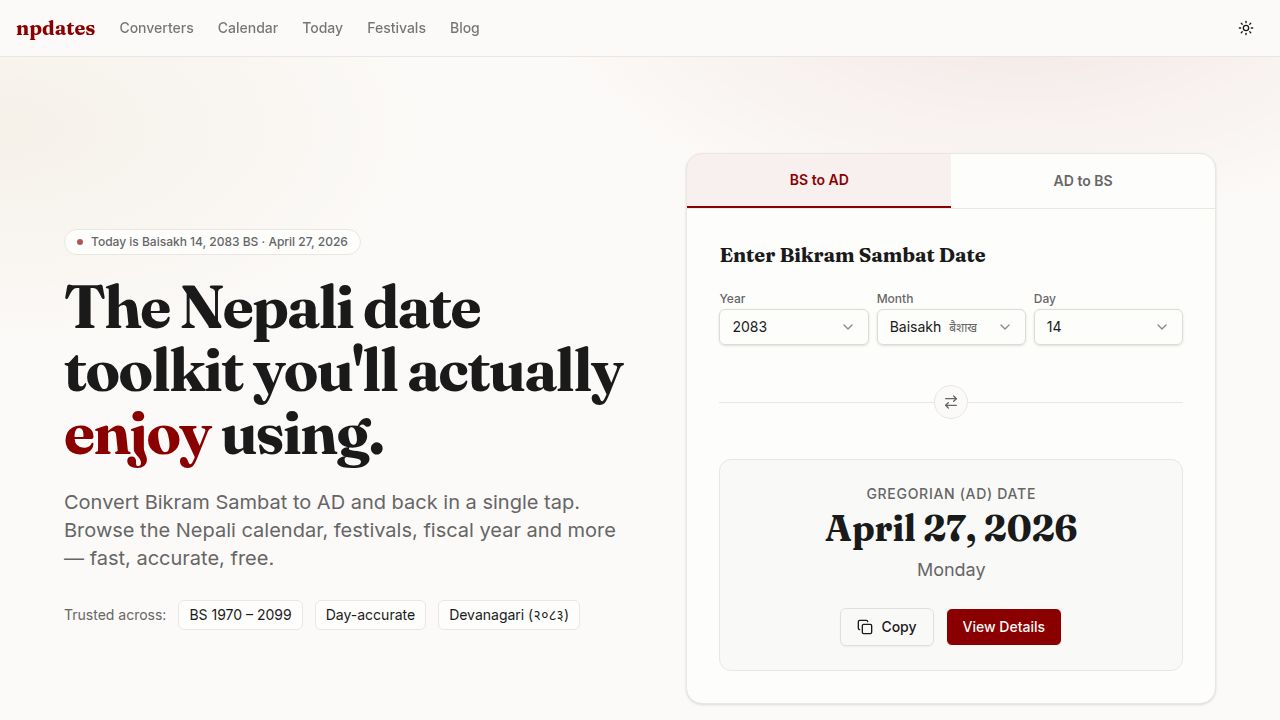
Because the cut-over date drifts by a day or two each year, the only reliable approach is to use a converter that consults a table of month lengths. Our AD to BS converter handles this correctly, and the reverse BS to AD converter is the home page. For the detailed mechanics, see how BS to AD conversion actually works.
Where you will see BS in daily life
Bikram Sambat shows up on far more documents than most outsiders expect:
- Citizenship certificates (nagarikta)
- Passports — printed in both BS and AD
- School-leaving certificates (SLC / SEE) and transcripts
- University admit cards and result sheets
- Government tenders and gazette notices
- Tax filings and PAN-related documents
- Property registration and land ownership documents (lalpurja)
- Marriage certificates and birth certificates
- Bank statements from state-owned banks
For Nepalis living abroad — and for foreigners working with Nepali partners — the practical need is to translate between BS and AD quickly and accurately. That is what tools like our age calculator and date-difference tool exist for. For developers, the same logic is available through our JSON API.
Frequently asked questions
Is Bikram Sambat the same as Vikram Samvat used in India?
They share the same era and name, but the regional implementations diverge slightly. Indian states that still observe Vikram Samvat (mainly for religious calendars) use somewhat different month-length conventions and sometimes a different new-year day. Nepal's Bikram Sambat is the version used in Nepali civic life.
How accurate is the BS calendar over long periods?
Because BS is sidereal, it drifts very slowly relative to the seasons — about 24 minutes per year compared to the tropical Gregorian year. Over a single human lifetime the drift is invisible. Over centuries the months would drift, but the annual recalculation by the Calendar Determination Committee keeps practical use accurate.
Can I write a BS date on an international document?
No. International forms, visa applications, foreign universities, and banks all want AD dates. Convert before you submit. For specific guidance, see our notes on BS dates for visa applications and converting your date of birth.
Does the BS year ever skip or repeat?
No. Like any solar calendar, BS years run consecutively. The year after 2082 is 2083, and the year after that is 2084. There are no leap years in the Gregorian sense, but month lengths absorb the extra fractional days each year.
Where can I see today's BS date?
Our today in Nepali date page shows the current BS date alongside the Gregorian date and the day of the week.
Practical takeaway
Bikram Sambat is not a quirky historical relic — it is the live, primary calendar of the Nepali state and Nepali daily life. If you work with Nepali documents, hire Nepali staff, do business with Nepali institutions, or just want to wish a Nepali friend a happy new year on the right day, learning to read BS dates and using a reliable converter is a small investment that pays off every time. Keep our BS to AD converter bookmarked, and you will rarely be caught out by the mid-April year boundary again.